
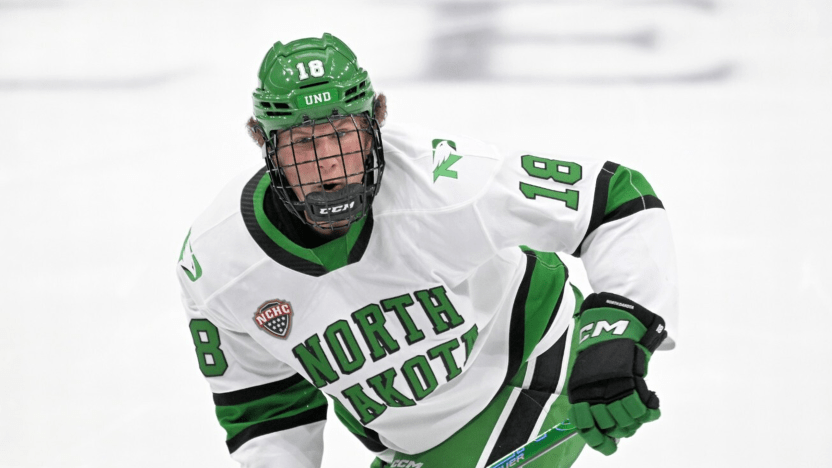

The 2026 NHL Draft class has been fascinating not because of elite, franchise-altering talent, but due to the lack of consensus around it.
Last season, Keaton Verhoeff recorded 21 goals and 24 assists (45 points) in 63 WHL games for the Victoria Royals, followed by 1 goal and 9 assists (10 points) in 11 playoff games. Before this season, it initially looked like the first overall pick would come down to Gavin McKenna or Keaton Verhoeff.
At 6’4″ and 212 pounds, the right-shot defenseman brought a heavy shot and strong production, especially in the playoffs, where he outperformed his already impressive regular season. However, his hype cooled considerably over the 2025-26 season, and opinions on him as a prospect now vary widely.

If you ask around, you’ll hear all kinds of conflicting takes.
Some scouts love his straight-line speed but say his agility needs work. Others point out how much his passing has improved this season, while plenty of people still see him looking lost with the puck and forcing turnovers.
At this point, I’ve come to the conclusion that Verhoeff is hands-down the weirdest top prospect I’ve ever watched. His compete level is rock solid and consistent, but pretty much everything else about his game is up and down.
Night to night, his overall impact and individual skills can swing wildly.
The Jump
This season, Verhoeff made a bold and somewhat unprecedented move, jumping straight to the NCAA with the University of North Dakota instead of staying with the Victoria Royals in the WHL.
Thanks to new rules allowing CHL players to keep their amateur status, we saw a wave of top young talent leave Canadian junior hockey for the NCAA. The chance to play against older, stronger, and more pro-ready competition was simply too good to pass up.
Verhoeff was one of the biggest names to make the leap, and given his size and production profile, many expected this jump to cement his status as the clear top defenseman in the 2026 NHL Draft class…
Instead, Verhoeff spent the season chasing consistency.
Just when one part of his game started to click, something else would fall off. One night he’d look like the most NHL-ready defenseman in the entire draft, and the next he’d play like a guy you might rank somewhere in the 10-15 range without thinking twice about it.
It’s important to remember that the NCAA isn’t a development league. It’s an amateur league full of older, stronger, more physically mature players. These guys have been developing longer and are physically further along.
On top of that, the talent gap between conferences and even between teams inside the same conference is huge. Some nights a better team just beats you outright and makes you look bad. Other nights you dominate and look like a superstar.
It’s probably going to take scouts and fans a while to recalibrate their expectations for underage players in the NCAA, no matter how big or skilled they are. We saw the same thing with Gavin McKenna – he had stretches where the production dried up, but he turned it on later in the year and has now positioned himself to go first overall to the Maple Leafs.
The Good, & The Bad
Verhoeff has clear talent. He has a combination of size and skill that is hard to find in the modern game. He uses this combo, along with above average Hockey IQ to create advantages for teammates and escape pressure.
On this play, Verhoeff shows off part of what makes him so intriguing: His strong puck protection skills, stickhandling ability, and improved passing.
North Dakota is getting pressured hard by a two-man forecheck.
When the first SCSU forward gets on him, Verhoeff fights through stick work, makes a quick cut, and sheds the guy off his hip, leaving him chasing air.
As the second forechecker closes in on a now stationary Verhoeff, he doesn’t panic. He uses a smooth backhand stickhandle to keep the puck away from danger, then makes a nice bank pass to his defensive partner.
When SCSU immediately jumps the partner, Verhoeff reads the situation perfectly. Instead of double-teaming, he sees the clear lane and lets his partner slide the puck into the space behind the net for the center. This keeps him open for a return option while he scans up the ice for the breakout.
Once the puck comes back to him, he delivers a crisp, tight-angled bank pass off the wall to his streaking center, and North Dakota transitions smoothly into the offensive zone.
Of course, because it’s Verhoeff, there are still things you can nitpick. He did shake the first guy, but he also left the puck exposed in open ice for a split second. If he’d lost it, he wouldn’t have been in position to body the forward off.
Also, after the final pass, he gets caught admiring it and takes a big hit into the boards. At 6’4″ and 212 pounds, he should be finishing those plays with a reverse hit to make guys pay for coming after him.
Verhoeff isn’t the most explosive skater, but that doesn’t mean he can’t close gaps quickly.
This play against Denver is a great example of how his size and defensive IQ let him multitask effectively off the rush. As Denver crosses center ice, Verhoeff is already tight on the left winger, which creates a big gap between him and his defensive partner. Denver’s #13 tries to exploit it, but Verhoeff uses his long reach and anticipation to close the distance fast, stripping the puck and shutting down a dangerous chance.
The concerning part is that he gets caught puck-watching. He misses his first stick check, gets it on the second try, but then turns his body toward the puck and straightens his legs for a moment instead of staying glued to his check and trusting his backchecking forward. That allows the puck to swing back to #13 for a shot.
The good news is he turned a potential high-danger chance into something much less threatening. Ideally, though, that second opportunity never happens. If he had stayed with his man, he likely would’ve prevented the shot entirely.
Here’s another good example of Verhoeff using his reach, stickhandling, and puck protection in the defensive zone.
While his teammate is tied up in a puck battle down low on the boards, Verhoeff sweeps in, positioning his body between the puck and the opponent while using his stick to disrupt the forechecker along the wall.
When the puck pops loose, he tries to control it but gets bumped, sending it off the net. As a second forward comes at him, he smoothly pushes the puck to his backhand, pulls it back to his forehand, and turns his body to shield it all in one fluid motion.
That sequence is indicative of high-end talent.
A lot of big, less mobile players his age would’ve just rimmed the puck along the boards and taken the icing. He then scans over his right shoulder, sees that his far-side winger doesn’t have a stick, and decides to turn and push the puck up the strong-side wall.
This is where his lack of explosiveness hurts him. He can’t separate from the forechecker, gets angled into the corner, and his attempted bank pass to the winger is picked off by a pinching defenseman, giving the opponent extended zone time.
On one hand, I love that he didn’t panic under pressure and took the extra second to scan and recognize his teammate had no stick.
On the other, he failed to scan the strong side, so he didn’t see the defenseman closing in.
You could argue he was just trying to make a play, but with a temporary manpower disadvantage, the safer option was probably to flip the puck high out and into the neutral zone, or just ice it to get a whistle and regroup.
This is exactly why I’ve emphasized Verhoeff’s inconsistency. He can look shaky on one shift and then turn around and make a play like this that highlights his strong passing and high hockey IQ.
When the puck gets rimmed around the wall, Verhoeff pivots quickly, skates backward, and retrieves it just as two Omaha forwards pinch in on him. Under pressure, he scans the strong side of the ice, and while on his backhand and facing the boards, delivers a beautiful tape to tape pass to his teammate.
Lesser players would’ve just tried to muscle the puck up the wall, but Verhoeff reads the situation perfectly.
He sees the forechecker’s stick positioned along the boards and knows his teammate is left-handed. A pass along the wall would have forced his teammate to handle it on the backhand, slowing him down and likely leading to a turnover with Omaha’s F3 bearing down.
Instead, he threads the puck behind the forechecker, giving his teammate space to control it, scan the ice, and make a safe chip out into the neutral zone for his linemates to chase.
I wanted to showcase this play to demonstrate Verhoeff’s improved playmaking, while also continuing to demonstrate his hockey IQ.
He makes a perfectly timed step up to knock the puck down in mid-air, and while stickhandling in the middle of all 5 SCSU players, is able to thread a nice backhand pass into the high slot for his teammate, who just misses giving North Dakota the lead.
Despite Verhoeff’s clear limitations in his skating and tendency to show a bit too much confidence with the puck, his playmaking has come a long way. In fact, I’d say it’s been the part of his game that has developed the most over the course of the season.

The growth in his playmaking ability has shown itself not only in the eye test, but from an analytical point of view as well, where Verhoeff is 97th percentile in passes, while also being 94th percentile in slot passes.
To put that into context, Carson Carels, another projected top 7 selection in the 2026 NHL Entry Draft, is 90th percentile in passes and 96th percentile in slot passes, while playing in a weaker WHL, against younger competition.
If you’re looking for an NCAA Defenseman to compare him to, we can look at 2025 1st round selection (14th overall, CBJ) Jackson Smith, and see that his passing and slot passing percentiles are in the 89th and 79th percentiles, respectively.
Keep in mind, Jackson Smith plays in the Big Ten Conference, which is considered to be significantly weaker overall than NCHC, the conference Keaton Verhoeff and the North Dakota Fighting Hawks play in.

Verhoeff’s combination of stickhandling and improved passing has also led him to becoming a very good transition player, where his only deficiency is being 42nd percentile in pass exits.
You may look at his 2nd percentile turnover rate and have major concerns, but I view this as a player who dove into the deep end of NCAA hockey as a 17 year old, while recognizing that most of his turnovers are low in the Defensive Zone, and because his team has not yet vacated the zone, allows them to adjust quickly, or low in the Offensive Zone, as the result of attempting a high danger pass to the slot.
When Verhoeff was in the WHL, his shot was one of the things people raved about, and rightfully so, given he scored 21 goals in 63 games. But this season in the NCAA, he didn’t record a single high-danger shot at 5v5.
The reason is pretty straightforward: he lacks the explosiveness and agility to consistently drive into high-danger areas at top speed.
That said, when he does get time and space to walk the puck downhill and unleash his shot, it’s still a weapon. The fact that he scored 6 goals in 36 games without a single 5v5 high-danger shot is actually a bit of an accomplishment.
On the power play, he was a legitimate shooting threat, which allowed him to freeze penalty killers and open up passing lanes. He showed a good (but not elite) ability to take advantage of those opportunities.
Wrap Up

When I watch Keaton Verhoeff, I keep coming back to the same question: Is his inconsistency and these clear limitations a sign that he lacks true top-end talent, or is it just the result of a 17 year old throwing himself into the toughest conference in college hockey before he was physically or mentally ready for that jump? Also, lets not forget that he was a goalie until he was 12 years old! He’s only been a defenseman for 5 years.
On the positive side, he has a very good wrist shot and has improved his playmaking to the point where he doesn’t have to rely on shooting to produce. His transition game is excellent, and the way he combines strong puck protection with a habit of constantly scanning for threats and opportunities is impressive.
On the flip side, he still panics under pressure at times, throws pucks away even when he has space, can often get caught puck watching, or trying to do too much with the puck, and can get walked on the rush by quicker players (as seen below).
The answer for whether the Canucks should Draft or Pass on Keaton Verhoeff is dependent on whether or not they believe their development team is in a position, both in terms of staff and analytics (research & development) to properly handle such a massive, high-stakes project like Verhoeff.
His size, decent mobility, shot, playmaking, and habits give him a tremendous skill set to build upon, but if the Canucks fail to recognize, understand, and develop a plan to hammer out the kinks in his game, fans will be looking at the Canucks using a 3rd overall pick on a 2nd pair, puck moving (but not offensive) defensive defenseman, and asking ourselves “What if they picked someone else?”.
Considering what we’ve heard about the Canucks lack of analytics (they’re still building up a proper department), and how the Canucks have failed to develop a 300+ game defenseman since Quinn Hughes (who is generational), I do not have confidence in this organization’s ability to properly develop Keaton Verhoeff.
Perhaps that can be mitigated by keeping him at North Dakota for another 2 seasons, but it’s not a risk that I would feel comfortable taking, personally.
There are quite a few franchises that I believe could develop him into the Top Pair, Right-Handed NHL Defenseman that every team dreams of, however.
When it comes to projectability, I see him as having the ceiling of being low end #1 d man, and a fantastic second pair play stopper as his floor.
If you want player comparables, he could range from being:
Ceiling: A slightly better Aaron Ekblad. 15-18 goals per 82 games, with 30-35 assists. Threat in all three zones, being able to shoot, distribute, and transition the puck, while also being able to use his size and mobility to prevent opposing defenses from being able to enter the zone and set up.
Floor: Adam Larsson, 5-10 goals a season, 15-20 assists per season, and makes a career out of being a large right handed defenseman who has to change his playstyle from being a potential two way threat to being a defenseman that relies on his size and decent mobility to kill plays, while also having the ability to exit the zone safely.
Next post, I’ll be writing about Carson Carels! I hope to have that article out on Wednesday. Thank you for reading!
Leave a Reply