
The NHL Draft is just 10 days away. As expected, the Canucks missed out on the two draft lotteries and will select 3rd overall.
The 2026 draft class offers strong supplementary depth. Gavin McKenna is the clear consensus No. 1 pick and is expected to be selected first overall by the Toronto Maple Leafs. However, the rest of the top five remains very much up in the air.
Ivar Stenberg, fresh off a historic SHL season and an excellent World Championship, is not guaranteed to go 2nd overall to San Jose. Recent reports indicate some teams are concerned about his size, a notable point given that Gavin McKenna is essentially the same size without drawing similar scrutiny.
Chase Reid, a 6’3″, 190-pound right-shot defenseman from the Soo Greyhounds, has also emerged as a legitimate candidate for the No. 2 pick. Despite an injury-interrupted season, he ranked 2nd in goals per game and 3rd in points per game among OHL defensemen.
His combination of size, skating, and transition ability gives him arguably the highest ceiling of any player in the draft. Selecting him would give San Jose another high-end piece to build around.
Other players in the mix for the top five include Carson Carels (Prince George Cougars, WHL), Keaton Verhoeff (North Dakota, NCAA), Alberts Smits (EHC Red Bull München, DEL), Viggo Björck (Djurgårdens IF, SHL), and Caleb Malhotra (Brantford Bulldogs, OHL).
“He continues to make an impressive showing for a first-year player even after Jake O’Brien (Seattle Kraken) and Marek Vanacker (Chicago Blackhawks) came back from NHL camps. He still has gotten his spot in the lineup, his place on the power play. That’s pretty telling for a 17-year-old to maintain that position when you’ve got all these high-end drafted players returning to the lineup”
– Dan Marr, NHL Central Scouting Director
If you look at Caleb Malhotra’s bio, and add his production on top of it, you can see why there would be hype around this player.
6 foot 2, 185 pound center with 29 goals, 55 assists, for 84 points in 67 Games.
He followed it up in the playoffs with 13 goals and 13 assists for 26 points in 15 Games.
So, why are so many Canucks fans so down on Malhotra? Lets dive into a few things that might be able to explain some of the angst out there.
1. He’s a Late Riser

On November 13, 2025, Caleb Malhotra’s draft stock was significantly lower than it is today.
At that time
Craig Button of TSN had him ranked at 17th.
Daily Faceoff had him at 27th,
Sam Cosentino of Sportsnet ranked him 28th, and
Elite Prospects’ Consolidated Ranking had him at 35th.
With the Vancouver Canucks drafting 33rd overall, a handful of scouts believed the team might have had a chance to select him in the second round if the draft had been held in November.
Malhotra had just completed a mediocre D-1 season with the Chilliwack Chiefs of the BCHL, recording 8 goals and 18 assists in 44 games. He ranked 12th on the team in goals and 10th in points. However, like this past season in Brantford, he elevated his game in the playoffs. In 21 playoff games, he posted 5 goals and 12 assists. He finished third on the team in scoring, well ahead of the next-youngest scorer on the roster.
As a 16-year-old, Malhotra stood out while playing alongside 19- and 20-year-olds, which was an impressive feat. In the 2023-24 season with the Vaughan Kings of the GTHL, he recorded 19 points in 21 regular season games and 12 points in 12 playoff games, elevating his production to a point per game in the postseason.
The conversation becomes more interesting when considering age. Malhotra was born on June 2, 2008. By comparison, Gavin McKenna was born on December 12, 2007, Ivar Stenberg on September 29, 2007, and Chase Reid on December 29, 2007. This makes Malhotra six to nine months younger than those three players who could be selected ahead of him. Combined with his pattern of strong second halves and playoff surges, it raises the question of whether his slower starts are simply a result of being younger. His body and mind may still be catching up developmentally, especially when adjusting to stronger competition in new leagues.
As a result, some believe he has more developmental runway left. By the time he reaches 20 to 22 years old, he could close the gap that currently exists between him and the top players in this draft class.
2. Organizational Need
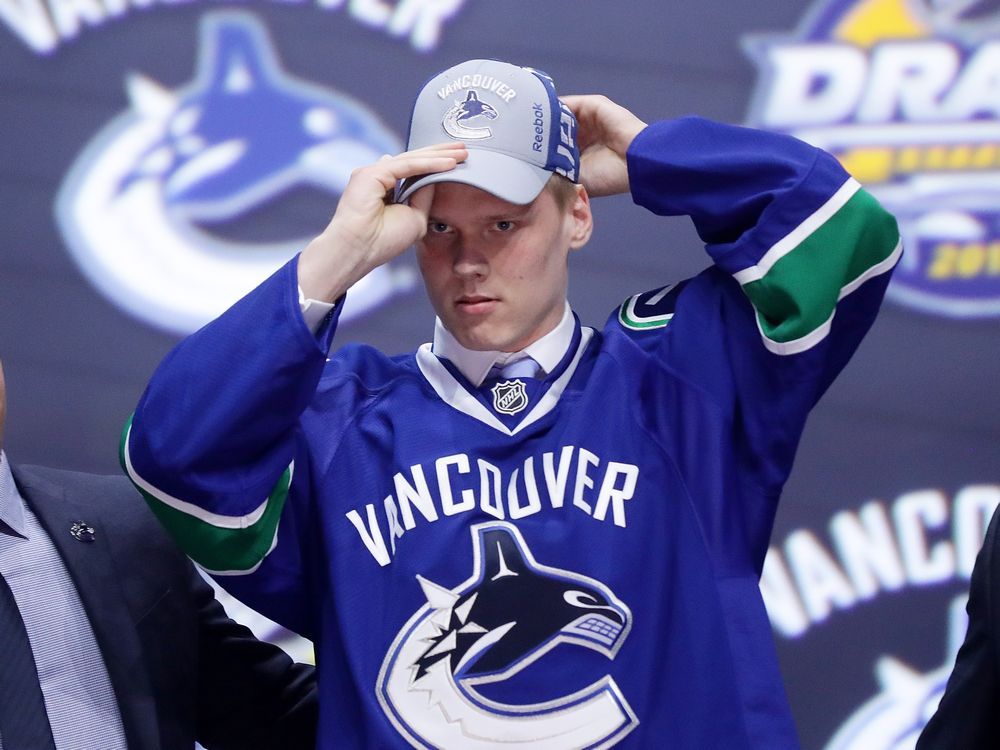
2016 was a rough year for the Vancouver Canucks, much like 2026. They finished third-last in the NHL and dropped two spots in the draft order.
The Toronto Maple Leafs selected Auston Matthews first overall. At second overall, the Winnipeg Jets took Patrik Laine. At third, the Columbus Blue Jackets reached on a 6’2″ center (now listed at 6’3″), Pierre-Luc Dubois. Dubois was ranked between fourth and eighth by most major scouting outlets but had risen sharply throughout the season. That pick briefly gave Canucks fans hope. At fourth overall, the Edmonton Oilers selected Jesse Puljujärvi.
Canucks fans across the province began to celebrate, believing that London Knights star forward and future Stanley Cup champion Matthew Tkachuk had fallen to them at fifth overall.
Then Jim Benning stepped to the podium and announced:
“With the fifth selection, Vancouver selects from the London Knights… Olli Juolevi.”
As Benning made the pick, Sportsnet cut to a shot of the Canucks draft party inside Rogers Arena. The audible deflation from the crowd was immediate when Juolevi’s name was called. Sportsnet had several seconds of dead air before the broadcast noted, “And a second ripple through First Niagara Center as Matthew Tkachuk is passed over for Olli Juolevi.”
Canucks nation is no stranger to costly mistakes at the draft table. Examples include:
- Jake Virtanen selected sixth overall in 2014 instead of Nik Ehlers or William Nylander.
- Jared McCann also selected in 2014 over David Pastrnak.
- Olli Juolevi in 2016 passed over in favor of Matthew Tkachuk or Clayton Keller.
- Vasili Podkolzin taken 10th overall in 2019 instead of Matthew Boldy or Cole Caufield.
Even in more recent drafts under the Rutherford and Allvin regime, many fans preferred Zach Benson over Tom Willander in 2023, and Victor Eklund or Kashawn Aitcheson over Braeden Cootes. While it is still too early to judge those picks definitively, there is a widespread belief that the Canucks tend to prioritize a player’s floor and certainty over high-upside potential, or make selections based heavily on positional need.
In Caleb Malhotra’s case, many fans believe selecting him would check both boxes. His perceived floor is a second-line center, and he is the highest-ranked center available in the draft. The Canucks need centers, particularly if they plan to move Elias Pettersson at some point in the next three years.
Stenberg may be smaller and a pure winger, but his offensive ceiling is viewed as much higher than Malhotra’s.
Reid has some clear weaknesses, especially his pinches and defending the rush, but if he improves his decision-making, he could develop into the best player in the draft.
Malhotra does not possess any standout elite individual traits. For some fans, this is concerning because it makes it harder to see how he can outperform players who show more skill in specific areas of the game.
This is also why fans get uneasy when they hear descriptors such as “he is a good human being” or “he has the drive to get better.” Leadership and work ethic are difficult to quantify, and it is even harder to project exactly how they will translate into on-ice production compared to rawer skill.
Defense is also harder to measure than offense, which leads many fans to assume that players labeled as ‘two-way forwards’ automatically have lower offensive ceilings.
“He’s a franchise No. 1 center… He’s a 200-foot player, but he also has the grit and edge – borderline meanness. He’s built for the heavy hockey you play in the playoffs”
– Anonymous NHL Scout, via The Hockey News
3. Production Profile vs. Analytics

Caleb Malhotra’s production profile is very assist-heavy. Only 34.5% of his points come from goals. Unless a junior forward is a major outlier in total points, it is traditionally better to see a closer to 50-50 split between goals and assists.
Seeing that Malhotra “only” scored 29 goals in 67 games has led many to question how he could ever become a 30-goal scorer in the NHL when he couldn’t even reach that mark in the OHL.
This is where analytics help paint a clearer picture.Under the hood, Malhotra profiles as a very good playmaking two-way center. His inside play is genuinely elite in areas such as zone entries, exits, cycle play, and transition plays through the middle of the ice. He excels at moving the puck from the perimeter into high-danger areas and generates positive outcomes in defensive zone retrievals, slot protection, rush and wall breakups, and board battles.
On the shooting side, his z-score (on a scale from -2.5 to +2.5, where 0 is the 50th percentile) shows xGoals at +1.0, which is 70th percentile. However, his shot frequency sits at roughly -0.30, or 44th percentile. This suggests his lower goal total is the result of prioritizing shot efficiency and quality over volume. His first instinct is usually to find a teammate in a better scoring position rather than shooting himself.
This is further supported by his puck management metrics. He ranks off the charts in completed plays, multi-touch sequences, and advantages created for himself, while sitting elite in puck touches, advantages created for teammates, created versus ended advantages, and completed play versus turnover rates.
However, his turnover rates, especially inside lane turnovers, are also extremely high, and his advantages-ended numbers are poor.
This profile makes sense for a developing player who views himself as a two-way play-driver rather than a pure goal scorer. He has been deliberately trying to push the limits of his playmaking, even if it leads to turnovers. While some see this as a flaw, in a developmental context it is actually a positive. He is experimenting and trying to add more deception to his game to create even higher-quality chances and tap-ins.
When Malhotra heads to Boston University in the fall, he will already have a strong understanding of how to create plays for others. The next step in his development is learning when to take advantage of those opportunities himself. If he can convert some of those inside-lane turnovers into shots, he should be able to maintain most of his assist production while meaningfully increasing his shot rate and goal output.
Wrap Up
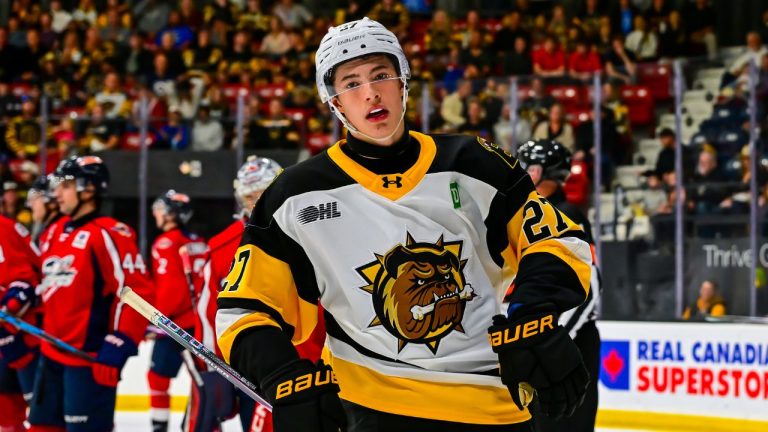
“I made my mark, made a name for myself. I still got a ways to go, but I did exactly what I wanted.” – Caleb Malhotra, via TSN.
Simply put, Caleb Malhotra is a special player. Personally, I have him ranked fourth on my draft board, first amongst all centers (I believe prospect pyramid formats are better than straight 1-through-32 rankings), and he is not as far behind Ivar Stenberg and Chase Reid (my second and third ranked players) as most people seem to think.
Should the Canucks draft him at third overall? I do not believe so. If Vancouver is set on Malhotra and has a good read on what Chicago, the New York Rangers, and Calgary want, they should explore trading down. This would allow them to acquire additional assets while still landing the center they covet.
Here are a few example trades using the PuckPedia Perri Pick Value Calculator that could make sense for the Canucks:
- To Chicago: 3rd overall
To Vancouver: 4th overall + 37th overall (TOR)
Result: Vancouver gets 63.56 value, Chicago gets 62.07 value - To New York Rangers: 3rd overall
To Vancouver: 5th overall + 26th overall (DAL)
Result: Vancouver gets 63.89 value, New York gets 62.07 value - To Calgary: 3rd overall + 78th overall (via CBJ)
To Vancouver: 6th overall + 30th overall (VGK) + 36th overall + 65th overall (VAN)
Result: Vancouver gets 69.1 value, Calgary gets 64.15 value
These are not perfect offers, and Vancouver would ideally leverage the third overall pick to gain more value than the calculator suggests. They serve as useful templates for the type of return the Canucks could target by moving down.
At the end of the day, the Canucks are going to get a good player whether they select Malhotra, Reid, or Stenberg. Making the pick itself is the easy part. Finding a way to maximize assets while still getting the player they want is much harder, and it is exactly what Ryan Johnson and the Sedins will need to do if they are going to rebuild this team into a championship contender five to seven years from now.
See you on draft day!
 Hockey By SAP
Leave a comment